

How To Pick Right Products For New Pharma Company
How To Pick Right Products For New Pharma Company– Have you finalized your company name, completed the registration, but still don’t know which products you should launch? You are not alone. This is one of the biggest decisions every new pharma entrepreneur faces. Imagine you had ₹10 lakh to invest today, what would you do?- spend it on products that the doctor prescribes every day or on medicine that might sit in a warehouse for months.The answer is obvious. This is exactly where many pharma companies make their first expensive mistake. A successful pharma company is never built by selling a large variety of products; it is built by selling the right product to the right market at the right time. If you are also struggling, then keep reading this blog. In this, we are going to tell you about how to pick right products for new pharma company.

Table of Contents
The Importance of Product Selection For New Pharma Business
Think of your product portfolio as the engine of your pharma business. It doesn’t matter how skilled your sales team is or how effective your marketing material is; your business will struggle if your products don’t meet the exact market demand.
The products that you choose directly influence:
- Your initial investment
- Profit margin
- Inventory management
- Distributor confidence
- Brand reputation
- Long-term business growth
- Doctor acceptance
Step-by-Step Guide to Pick the Right Products for a New Pharma Company
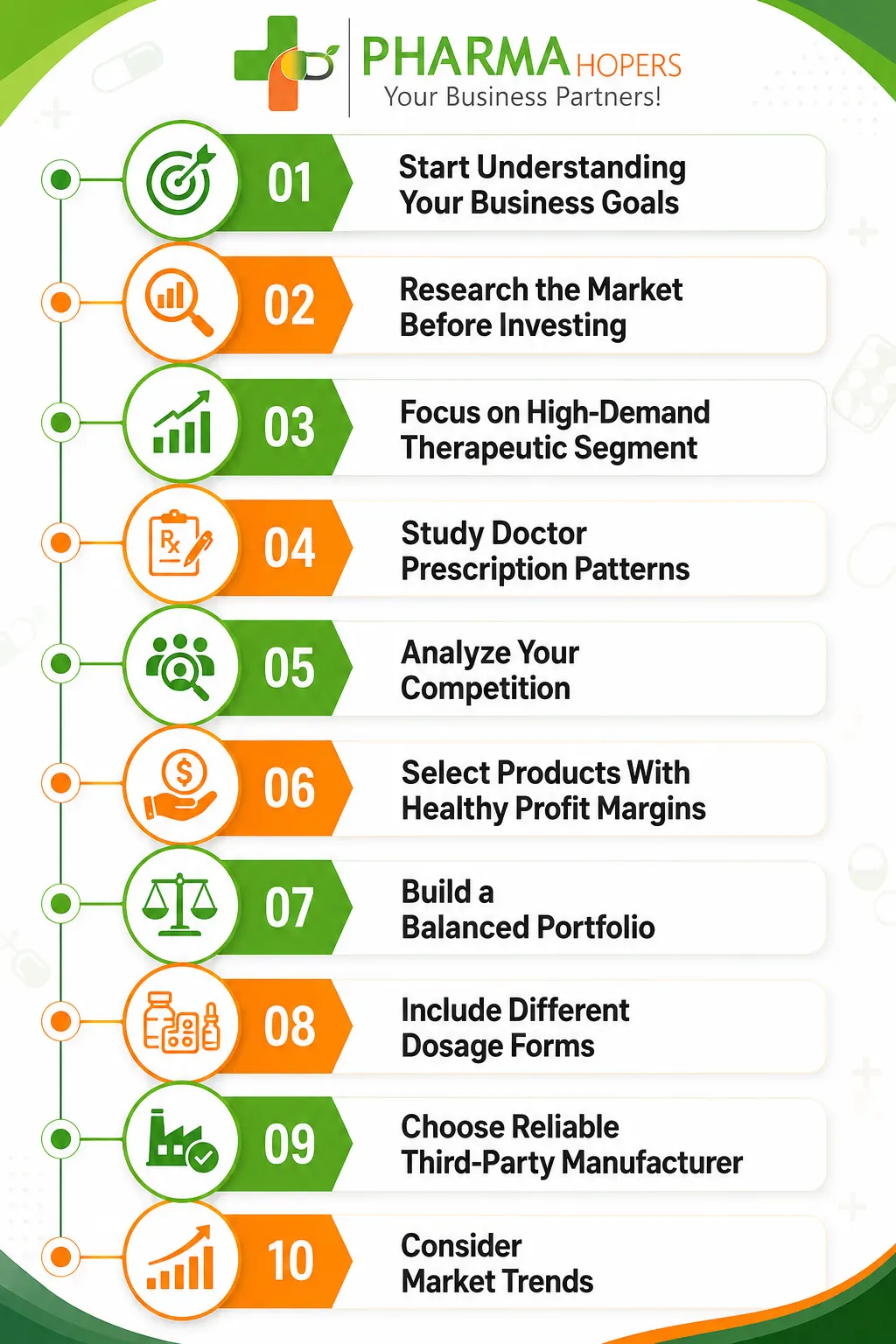
When you choose a product for your new pharma company, the goal should not be just filling catalogues. Having a high-demand product list in your company can help you grow your business to the next level. Let’s see how to pick the right products for a new pharma company:
Step 1: Start Understanding Your Business Goals
Before looking at the product list, always think about “what type of pharma company do you want to build?” You may sound basic, but this question really helps you to decide on a product. Every medicine or product you introduce should support your overall business vision. By understanding your business goal first, you can easily:
- Avoid unnecessary investment
- Build a focused product portfolio
- Plan your inventory more efficiently
- Expand strategically instead of randomly
- Target the right healthcare professional
Behind every successful pharma company, there is a mind that knows exactly what they want to sell and to whom.
Step 2: Research the Market Before Investing
Many first-time entrepreneurs discover this reality too late- product availability doesn’t tell the demand. Some companies invest heavily in medicine simply because the manufacturer recommends it or competitors already have it. But this often results in slow-moving inventory or blocked capital.
Always spend time understanding the market before investing. You can search follow areas:
- Most frequently prescribed medicines
- Which therapeutic segment is growing rapidly?
- Which product is facing a regular shortage?
- Which medicine offers an opportunity for new entrants?
- Which brand is famous in the market?
By understanding this market, you can know what needs to be added to your pharma business.
Step 3: Focus on High-Demand Therapeutic Segment
Every medicine sells at its own pace, as some products are prescribed every day while others are used only occasionally. For new pharma business owners, focusing only on high-demand therapeutic segments is one of the safest ways for steady cash flow and to build a strong market presence.
Here we are sharing some most popular high-demand segments:
- Generic medicine
- Gastrointestinal care
- Antibiotics
- Anti-allergic medicines
- Nutraceuticals
- Diabetes care
- Women’s health
- Pedicatrics
- Pain management
These categories generally have regular or consistent demand that offer opportunity for repeat business.
Step 4: Study Doctor Prescription Patterns
Doctors are one of the biggest pharma product demand drivers. If doctors don’t prescribe your products, then selling them becomes more difficult. Before choosing the product, you should understand the prescription behaviour that allows you to select the product with real market acceptance.
Here, we are sharing some ways to gather prescription insights:
- Meet practicing physicians
- Interact with medical representatives
- Visit clinics and hospitals
- Attend medical conferences
- Study pharmaceutical prescription reports
The best-selling products are always those that doctors already trust and prescribe.
Step 5: Analyze Your Competition
By analyzing the competition, you can also know the most demanding products of the market. Blindly entering highly saturated markets without any differentiation can make growth more difficult. You should analyze your competitors based on:
- Product range
- Packaging quality
- Promotional activities
- Market reputation
- Distributor support
- Product availability
- Pricing strategy
Always remember, competition isn’t your enemy. They are often the biggest source of market intelligence.
Step 6: Select Products With Healthy Profit Margins
Sales are important, but profits are even more important. No doubt, many products generate excellent sales but leave very little profit. That’s why you should evaluate every product by demand as well as profitability.
Always choose those products that offer:
- Consistent demand
- Sustainable margins
- Repeat purchase potential
- Healthy return on investment
- Long-term profitability
Profit margin is important because revenue keeps your business running, and profit helps your business grow.
Step 7: Build a Balanced Portfolio
Building a cricket team entirely of bowlers. Will this perform well? Probably not. This same principle applies to your product portfolio. You should maintain a healthy balance between fast-moving and specialty medicines. Some examples:
- Dermatology
- Gynecology
- Neurology
- Orthopedics
- Pediatrics
With a balanced portfolio, your business minimizes the risk while maximizing the growth opportunities.
Step 8: Include Different Dosage Forms
A different patient has different needs, as adults prefer tablets, children may require syrups, and hospitals may need injections. By offering multiple dosage forms, you can make your portfolio more complete and attractive.
Here are some common dosage forms you can add to your pharma business:
- Tablets
- Capsules
- Gels
- Syrups
- Dry Syrups
- Injections
- Creams
- Ointments
- Sachets
- Oral drops
- Suspension
It is a fact that the more patient-friendly your portfolio is, the more market-friendly your business will be.
Step 9: Choose a Reliable Third-Party Manufacturer
Your manufacturer‘s production quality becomes your company’s reputation. That’s why choose the reliable and trusted manufacturer. Always look for manufacturers that offer:
- WHO-GMP Certification
- ISO Certification
- Modern manufacturing facilities
- Strict quality control
- Transparent pricing
- Timely production
- Strong regulatory compliance
Always remember, your company’s name should appear on the products, but customers always judge the quality behind it.
Step 10: Consider Market Trends
The pharmaceutical market is dynamic. New diseases emerge daily, healthcare priorities change, and patient expectation continues to evolve. Always choose a product portfolio that performs exceptionally well; five years ago may not deliver the same results today.
Always keep your eye on growing healthcare segments:
- Nutraceuticals
- Women’s wellness
- Pediatric nutrition
- Cardiac care
- Orthopedic products
- Dermatology
- Respiratory care
- Immunity-boosting supplements
Conclusion
I hope this might have been helpful for you to find the best ways to pick the right pharma product for your new pharma company. So, if you were struggling to choose the products, then go through these tips and implement them to get the best and most effective results.
Frequently Asked Questions about How To Pick the Right Products for a New Pharma Company
Question. How many products should we launch initially in a new pharma business?
Answer: For a new pharma business, launching 20-50 well-selected products is an ideal approach. Instead of focusing on large numbers, you should focus on high-demand products.
Question. Which one is more profitable- generic medicines or branded products?
Answer: If you select your pharma products strategically, both can give you profit. Generic medicines have consistent demand and are easier to sell, while branded products offer high profit margins and help establish your company’s identity.
Question. Should I add seasonal medicines to my new pharma portfolio?
Answer: Yes, by including seasonal medicines, you can easily boost sales during specific times of the year. Products like cough syrup, ORS, antifungal cream and fever medications often have increased demand during seasonal changes.
Question. Will nutraceutical products be beneficial for my pharma product portfolio?
Answer: Absolutely. Nutraceutical products are going to be one of the most profitable segments due to increasing healthcare awareness and preventive healthcare trends.
Question. How can we address local healthcare needs for product selection?
Answer: To identify the local healthcare needs, you can study disease prevalence, consult local doctors, analyze pharmacy sales, review hospital treatment patterns and monitor public health reports.
Question. What are the ways to reduce the risk of selecting the wrong pharma products?
Answer: To reduce the risk of selecting the wrong pharma products, you should make data-driven decisions rather than relying on assumptions. You can conduct market research, analyze competitor product portfolio, assess profit margin and start with a limited product range.
Question. How often should I add new products to my pharma business?
Answer: A pharma company should evaluate its product portfolio after every 6 to 12 months and introduce new products based on market demand and business growth.