

Benefits of Third-Party Manufacturing in Pharma
Benefits of Third-Party Manufacturing in Pharma: Want to build a pharma brand? Have the products in mind? You have the products in mind, a target market, or even a distribution network that is ready to go. But now comes the issue: setting up your own manufacturing unit means crores in capital, the need to hire a full production team, and equipment that needs constant maintenance. It is also true that for most pharma businesses, this issue is simply too high and too expensive.
To help you with this, third-party manufacturing comes in. Third Party Manufacturing in Pharma has become one of the smartest business strategies in pharmaceutical industry in India in present time. When you partner with a WHO-GMP-certified third-party manufacturer who produces your medicines under your brand name, you don’t need to build your own factory. Third-party manufacturing helps you reduce the cost as well as time.
No matter if you are a first-time pharma entrepreneur or a PCD franchise owner who is looking to launch your own brand, or an established marketer who wants to expand your product range. In this guide, you will get to know everything about the benefits of third-party pharma manufacturing and why you can consider third-party manufacturing in pharma.
Table of Contents
What is Third Party Manufacturing in Pharma?
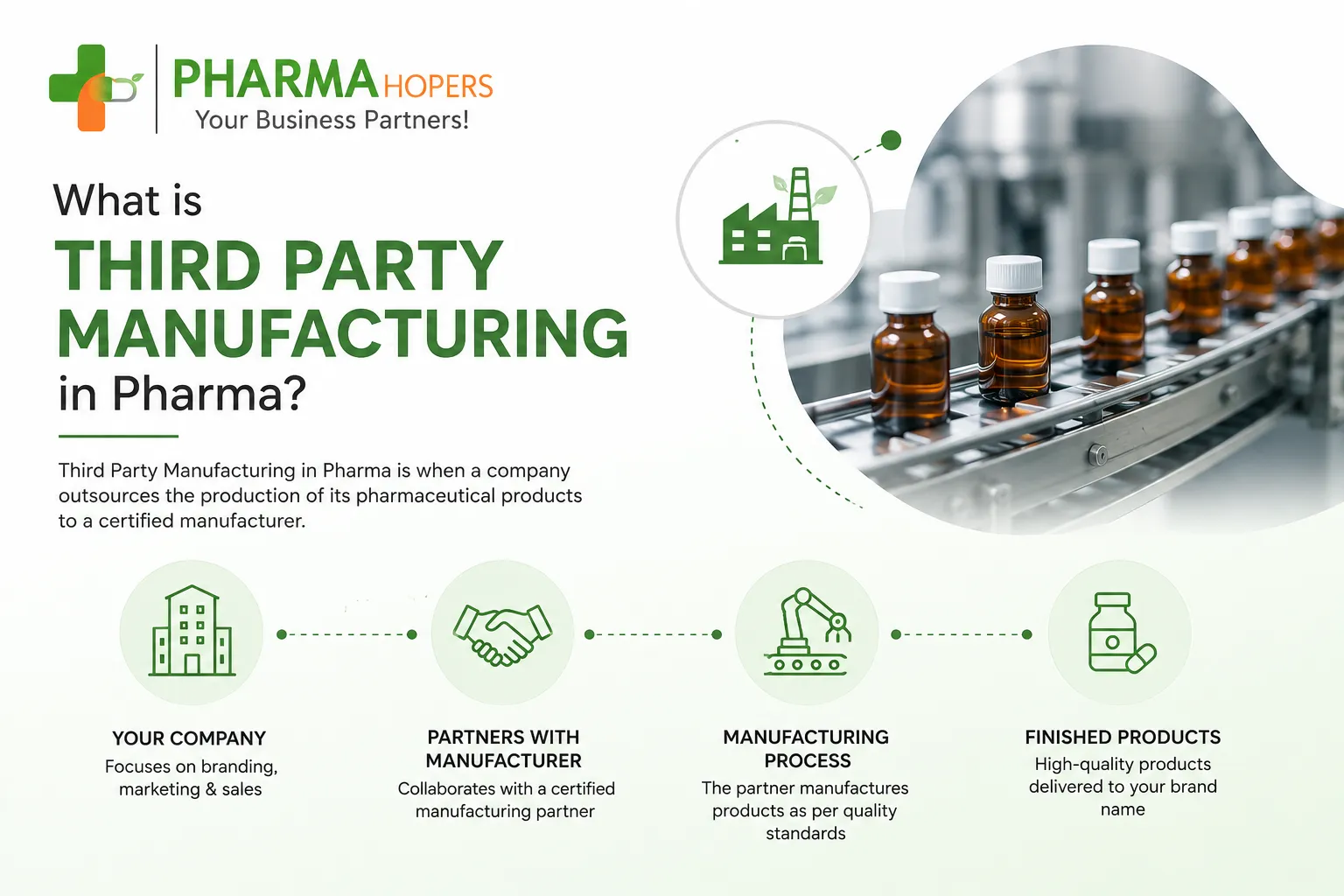
In India, third party manufacturing (TPM) or pharmaceutical contract manufacturing (PCM) is a prevalent business model where a pharmaceutical company utilizes the processes of a licensed and expert manufacturer to produce its therapeutic medications. Third-party manufacturers are responsible for production, quality checking, and packaging in accordance with your specifications.
The TPM/PCM business model is very popular in India and is referred to as “The Pharmacy of the World.” The many third-party pharmaceutical manufacturers located in India have achieved global certifications by certifying bodies such as WHO-GMP, ISO, GLP, DCGI, and in many cases, US FDA and EU-GMP, making these manufacturers trustworthy partners within both the domestic and export supply chains.
Third Party Manufacturing vs. Own Manufacturing Unit — A Quick Comparison
| Factor | Own Manufacturing Unit | Third Party Manufacturing |
| Capital Investment | Very High (₹5–20 Cr+) | Low to Moderate |
| Setup Time | 12–24 months | 1–3 months |
| WHO-GMP / ISO Compliance | You must acquire | Already in place |
| Equipment & Infrastructure | Your responsibility | Manufacturer’s facility |
| Regulatory Burden | Fully on you | Shared with manufacturer |
| Scalability | Limited by plant capacity | Flexible, on-demand |
| Product Range Expansion | Requires new infrastructure | Easy via manufacturer’s lines |
| Business Risk | High | Significantly lower |
| Focus on Core Business | Divided | Full focus on branding & sales |
Top Benefits of Third-Party Manufacturing in Pharma
1. Substantial Savings — Cut Expenses
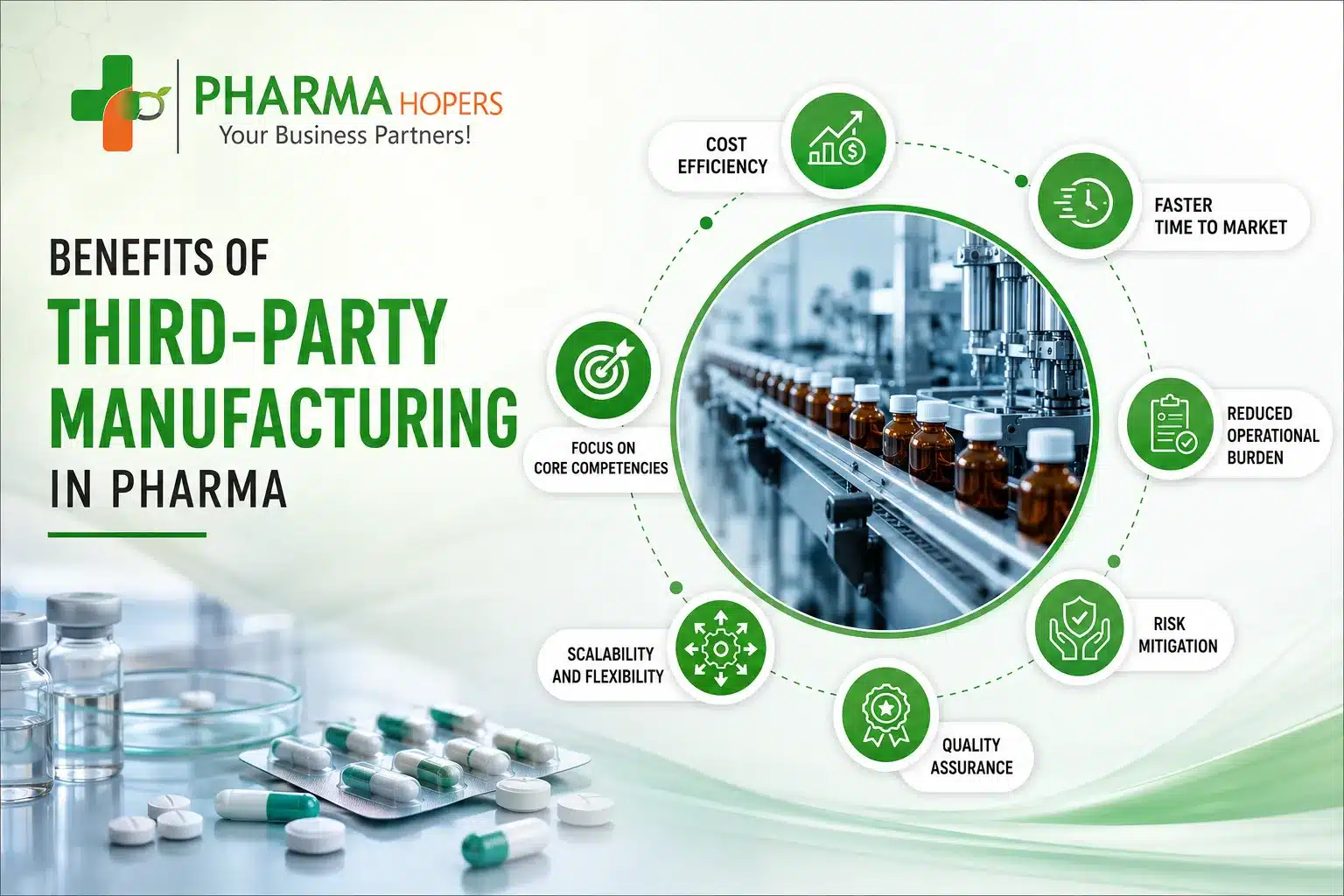
The most significant benefit you can expect from third-party pharmaceutical manufacturing is the reduction of costs. In addition, if you manufacture your product in India, you are likely to save between 30%-35% compared to manufacturing it in the USA or Europe. Third-party contract manufacturers create a facility and equipment investment, as well as a workforce dedicated to your product.
You will not incur any downtime or the cost associated with idle equipment when partnering with a contract manufacturer; You are billed only for the units produced. This can give you a competitive edge over your competition by having more streamlined processes and reducing your time to get to profit for start-up and expanding pharma companies.
2. Quick Launch of Product — Get to Market Within Weeks Rather Than Months
A decrease in operational costs and significantly shorter timelines will help you launch your product faster with the help of a third-party manufacturer. In addition, a third-party contract manufacturer will have existing infrastructure costs, drug certifications, manufacturing quality systems, etc. You can eliminate the long transitional period involved with establishing a manufacturing site by using a third-party contract manufacturer to produce your products.
A third-party contract manufacturer can take your final formulation of a tablet, syrup, capsule, soft gel, or injectable drug product and manufacture and deliver it to you within 15-30 days for standard dosage forms; This is impossible for a newly established facility to match.
3. Access to WHO-GMP certified facilities & expert teams
One of the biggest benefits of third party manufacturing is that it offers you access immediately to all of the production infrastructure you’ll ever need – ultimately allowing you to achieve your goals successfully. Most reputable third party manufacturers are certified in WHO-GMP, ISO, and GLP; they follow a rigorous regulatory compliance process, helping to ensure your products are compliant with all of the standards that exist in the industry.
In addition to certifications, you will also have access to professional pharmacists, quality control scientists and manufacturing specialists who are working around the clock to ensure products remain consistent, pure and safe.
4. Scalability & Flexibility of Production
With pharma contract manufacturing, you also have the opportunity to scale production based on your needs — up or down — without the limitation of your own production facility’s capacity. Therefore, you can adjust your production volume higher or lower depending on product launches or your market demand.
This flexibility is extremely important for pharmaceutical businesses contemplating expansion into other therapeutic areas like dermatology, gynecology, pediatrics or nutraceuticals.
5. Freedom to Focus on your Branding, Marketing & Distribution
Once you have totally transferred all of the responsibility for production, you will have your entire time and resources to focus on what makes you successful as a Pharma; creating relationships with healthcare providers, developing your PCD pharmaceutical franchise network and building your reputation and expanding your distribution.
Outsourcing production allows your team to focus 100% on marketing, sales strategies, and building relationships with healthcare professionals. This is considered one of the major reasons why pharma third-party manufacturing companies are becoming popular in the Indian branded generics market.
6. Comprehensive Product List Without Additional Investment
Are you interested in providing tablets, capsules, dry syrups, ointments, soft gels, sachets, and injectables with your name on them? A manufacturer must build separate production lines for each type of product; by using a third party manufacturer, you can partner with one who has a complete line of capabilities for all of these products.
This is how many pharmaceutical companies have quickly expanded into allopathic pharmaceuticals, Ayurvedic products, nutraceutical products, and cosmetics, without a capital investment.
7. Reliable Quality Assurance and Consistent Batch Quality
A well-established third party pharmaceutical manufacturer invests significant resources in quality control (QC) and quality assurance (QA) — including testing of raw materials prior to production, in-process checks during production, and testing of the finished goods before they leave the manufacturer.
All finished products are delivered with a certificate of analysis (COA), batch manufacturing records, and full traceability documentation, all of which provide you with complete confidence in the quality of your products.
8. Lower Risk & Regulatory Burden
Using a third party manufacturer greatly lowers the regulatory risk to your company, since the manufacturer must handle the majority of the regulatory issues associated with inspections, Good Manufacturing Practices (GMP) audits, license renewals, and compliance amendments — thereby facilitating the entry of your company into the pharmaceutical market and reducing the regulatory risk.
If you find that your product does not achieve your desired level of success, you will not be stuck with an idle ₹10 crore manufacturing facility. Your financial exposure is significantly less than it would be if you were building your own facility, while your ability to adjust to the market is significantly more significant than if you had your own manufacturing plant.
9. Documentation & Regulatory Support
Most reputable contract manufacturing organizations in the pharmaceutical industry can offer documentation support to clients such as batch records (including all critical manufacturing parameters), stability study reports (for APIs), certificates of analysis and analytical reports for APIs and drug products.
Some of the most well-known CDMOs are evolving into larger scopes of services. A few examples include providing services like formulation development, stability testing and regulatory assistance through their expanding service offerings.
10. Ideal for Export Markets
Pharmaceutical companies looking to enter foreign markets can benefit from partnering with WHO-GMP certified third party manufacturers located in India – especially in manufacturing hubs such as Baddi, Haridwar, Ahmedabad, and Hyderabad. These places offer the necessary quality assurance credentials required by foreign governments for exporting products made in India to other countries.
The extent of FDA-approved and WHO-GMP-compliant drugs manufactured in India allows for the exporting of pharmaceutical products to over 200 countries worldwide. By working with an experienced third-party manufacturer, pharmaceutical companies can access international markets without the expense of developing their own facility that meets the requirements for exporting.
Who Can Benefit from Third Party Manufacturing?
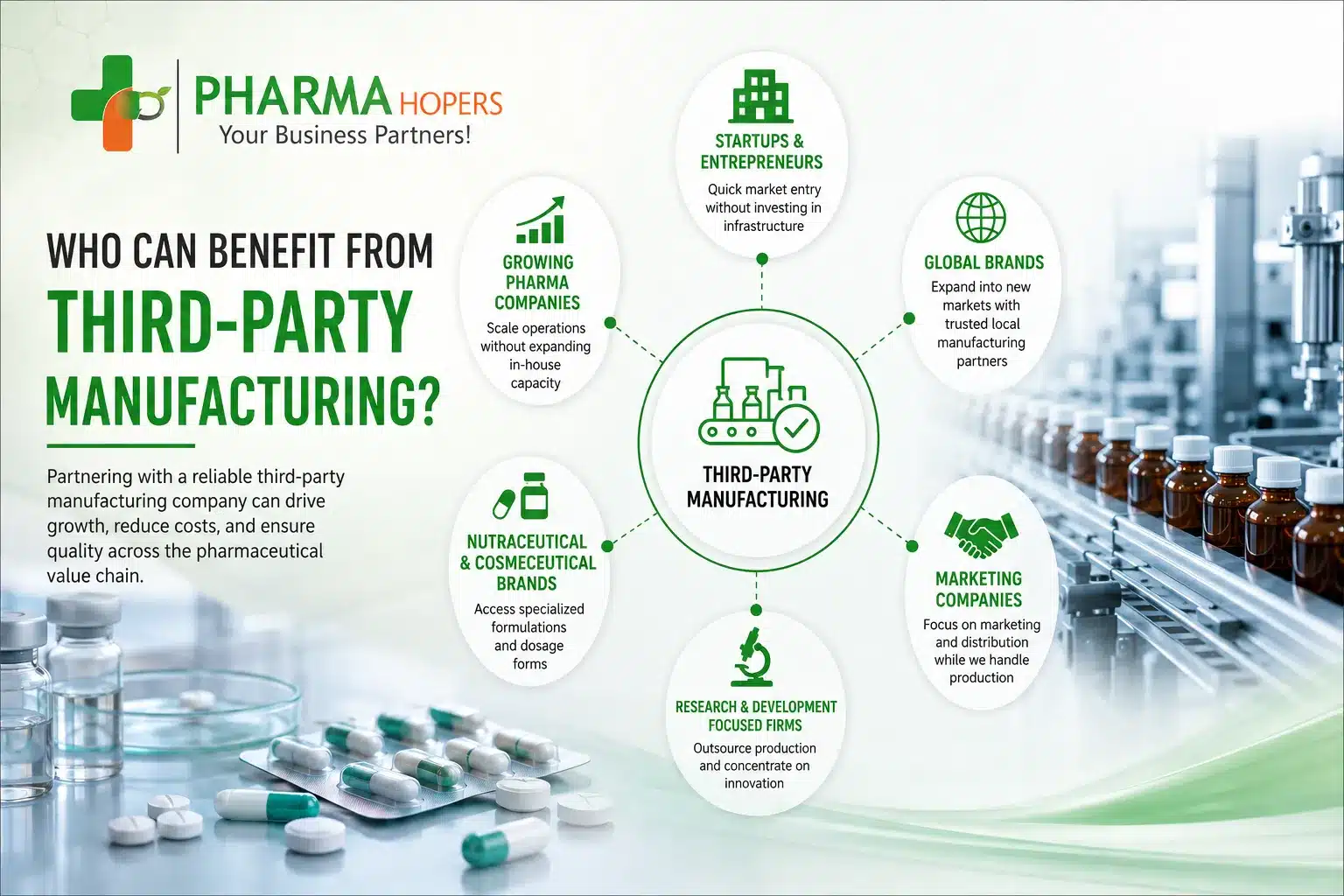
Third-party manufacturing is beneficial for:
- New entrepreneurial pharmaceutical companies that want to create a brand without having to build their own manufacturing facility.
- PCD franchise and distribution companies that need to develop their own-brand product line.
- Experienced pharmaceutical manufacturers looking to expand into new therapeutic fields.
- Distributors and wholesalers are converting to branded product ownership.
- Nutraceuticals and Ayurvedic manufacturers are looking to comply with the pharmaceutical supply chain.
- Exporters need WHO-GMP certified substrates to meet quality assurance/testing requirements for product export.
What to Check Before Choosing a Third Party Pharma Manufacturer
- GMP certificates: Should be at least WHO-GMP, ISO, and DCGI
- Make sure they produce the dosage forms needed for your product range
- Confirm that the MOQ is suitable for your current stage of business
- Make sure there is a quality assurance/ quality control lab with tested processes.
- The manufacturer has a clean history of complying with regulations (no past violations or licenses revoked)
- Have written assurance of good timelines for production time and delivery time
- All documentation associated with manufacturing (batch records, Certificates of Authenticity, stability data, etc.) is available
- There should not be any hidden fees or costs in your manufacturer’s agreement
PharmaHopers is making it significantly easier to connect pharmaceutical businesses with manufacturers that are certified and verified throughout India all in one place.
Wrapping Up!
In conclusion, utilizing third-party manufacturing for your pharmaceutical business is not only a method of getting product manufactured by businesses who don’t have enough resources, but in reality, it is the best business model for most pharmaceutical companies, due to cost-effectiveness, quality assurance decisions made in a timely manner with flexibility and allowing you to focus on building a great brand without the operational distractions.
If you are either just starting out or have multiple product lines, partnering with the correct pharmaceutical contract manufacturer who is also WHO-GMP certified through PharmaHopers will be one of the best business decisions you make.
Frequently Asked Questions (FAQs)
Q. Is it legal to manufacture pharmaceuticals in India via a third party?
Ans. Yes! Third-party manufacturing can be done legally in India. A third-party manufacturer should have a valid Drug Manufacturing License (in accordance with the Government of India’s CDSCO regulations), and the company for which the third-party manufactured products are to be sold must have its own Drug License issued by the Government of India. The two Parties must operate under an agreement for manufacturing and under the applicable State Drug Authority regulations.
Q. How much would it cost to have pharmaceuticals manufactured through a third party?
Ans. Manufacturing costs are determined by the product type, the complexity of its formulation, and the quantity being produced. It is generally 30-40% less expensive to have your products manufactured by a Contract Manufacturer instead of establishing your own manufacturing facility. The Minimum Order Quantities (MOQ) typically range from 1000 to 5000 units, depending on the dosage form of the product.
Q. What documentation is required for third-party pharmaceutical manufacturing?
Ans. The following documents will be necessary: a valid drug license, GST registration, product formulation & specification, as well as a signed manufacturing agreement. In addition to these documents, the Contract Manufacturer will provide batch production records, a certificate of analysis, and any additional GMP certification documentation for each batch of product produced.
Q. What is the difference between contract and third-party pharmaceutical manufacturing?
Ans. Contract manufacturing and third-party pharmaceutical manufacturing are two different terms describing the same process: outsourcing the production of pharmaceutical products to an independent, specialized manufacturer. The term “contract manufacturing” is used for the larger global Industry, while the term “third-party manufacturing” is more frequently used within the context of the Indian Pharmaceutical Industry and in the Pharmaceutical Franchise Business.
Q. How can I search for a reputable third-party pharmaceutical production company in India?
Ans. Look for established B2B pharmaceutical manufacturers using a reliable pharmaceutical database such as PharmaHopers. Check that these manufacturers have GMP Certificates from reputable certifying bodies, significant customer bases, positive histories of regulatory compliance, provide dosages that meet your needs, and have minimum quantity order requirements suitable for your production plans.
Can I acquire WHO-GMP certified products through third-party pharmaceutical manufacturers?
Ans. Yes. Many reputable third party manufacturers based in India’s pharmaceutical regions, such as Baddi, Haridwar, Ahmedabad, and Hyderabad, have obtained WHO-GMP Certification and ISO Certification for their production processes. Therefore, their products are acceptable for both domestic sales and export to more than 200 countries.
Q. What is the normal delivery time for third-party production in a pharmaceutical company?
Ans. Reputable and established contract manufacturers will typically deliver products in 15 to 30 days from the date of receipt of the order. In contrast, developing new products through a contract manufacturer can take from 45 to 90 days, depending on the complexity of the product, due to the need for formulation development, stability testing, and approval by the appropriate government agency.
Q. Will I be held responsible for QC operations if I utilize a third-party manufacturer?
Ans. Although the manufacturer will be responsible for the quality control of your products, you should always review the manufacturer’s production batch records and certificates of analysis before you accept product deliveries. You should also conduct an audit of the manufacturer’s facility on a periodic basis to ensure continued compliance with GMP standards for manufacturing quality.
Q. I have a small business. Can third-party manufacturing be an ideal choice for my business?
Ans. Of course. Third-party manufacturing is ideal for small and emerging pharma businesses. It can eliminate heavy infrastructure investment and allows them to launch fully branded, GMP-certified pharma products.
Q. What is the global pharmaceutical contract manufacturing market size?
Ans. GrandViewResearch reports that in 2025, the global pharmaceutical contract manufacturing market size was valued at USD 141.7 billion and is projected to grow from USD 155.1 billion in 2026 to USD 310.9 billion by 2033. This market value is projected to grow at a CAGR of 10.4% from 2026 to 2033. These values show the demand for third-party manufacturing or contract manufacturing in the pharmaceutical sector.