

PCD Pharma Franchise Marketing Agreement

In India, thousands of entrepreneurs start their pharmaceutical distribution businesses through the PCD Pharma Franchise Marketing Agreement model every year because of the low investment and monopoly selling rights. In India, the pharmaceutical market is valued at roughly Rs. 5,20,000 crore (US$60.32 billion) in 2026 and is expected to grow at a CAGR of 5.74%, reaching somewhere around US$79.74 billion by the end of 2031, according to IBEF. In this blog, PharmaHopers will provide you with everything you need to know about the PCD Pharma Franchise Marketing Agreement, its legal essentials, key clauses & compliance checklist.
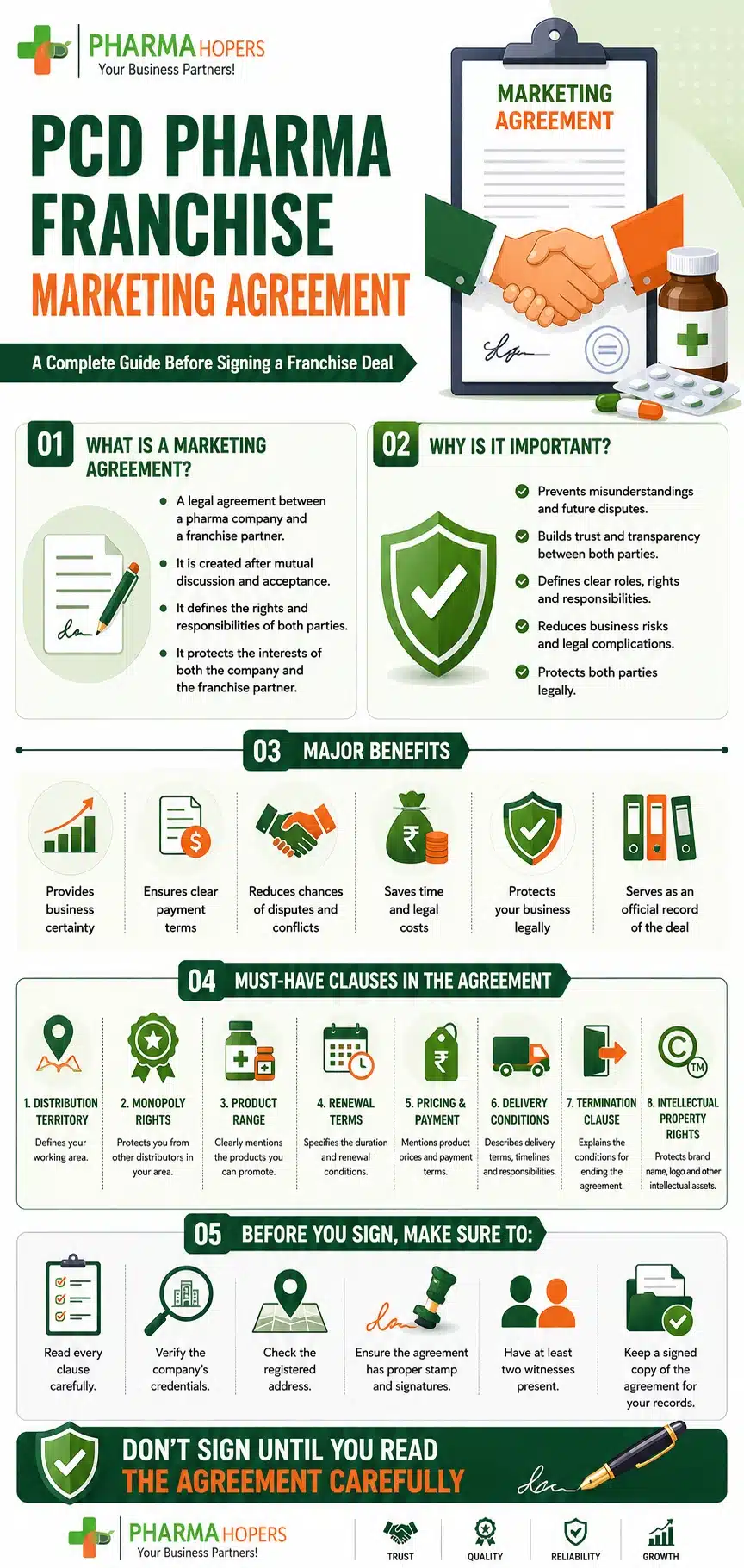
Table of Contents
What Makes This Agreement a Legal Contract, Not Just Paperwork
The PCD Pharma Franchise Marketing Agreement is not merely an internal affair of the company, it is a legal contract according to the laws of India. As defined in Section 10 of the Indian Contract Act of 1872, the agreement reaches the status of a legal contract when it is made with the free consent of the parties capable of making contracts, for a legal consideration, and for a legal object.
The importance of this fact should change your perception of the document. It is not an advertisement for the partnership, it is also a document that can be presented in court if the partnership subsists no more.
Why More Franchise Partners Are Insisting on a Written Agreement in 2026
The pharmaceutical franchising in India has come a long way from the unregulated operations based on oral agreements. There are several reasons for the popularity of written agreements between parties:
- The growth of the pharmaceutical market in India is expected to be between 8 and 10% in FY26, according to the report provided by ICRA including active sales teams and new products available.
- India is home to more than 3,000 pharmaceutical suppliers and around 10,500 production units many of which sell through PCD companies.
- According to PharmaHopers, those wishing to start a pharmaceutical franchise have over 2,865 PCD pharma franchise companies to choose from.
The increasing number of companies vying for the attention of franchise partners means entrepreneurs have more choices, yet more companies mean franchise partners must be shrewd with their agreement signing since terms vary.
What Is A Marketing Agreement in PCD Pharma Franchise Business?
The Pharma industry majorly appoints franchise holders across the globe. This is done for the purpose of increasing sales and marketing. PCD Pharma franchise is a small form of pharma distribution and wholesaling. A legal written agreement made out of negotiation of the parties is called a marketing agreement.
A market agreement is a form of a contract and not a contract. If the terms and conditions are being made by the Pharma Company and you have little to no control, then you are likely signing a contract. In the case of an agreement, the whole paper is written after mutual understanding from both sides.
The two parties first discuss the terms and conditions put in front of themselves. After a mutual give-and-take discussion, the agreement is written and signed to come into existence. The franchise offers them the right to make bulk purchases from the company. Then they can resell the products and medicines at profitable rates.
Why Is It Essential To Have A PCD Pharma Franchise Marketing Agreement?
A marketing agreement is an essential driving force for better quality of work. Failure to perform or termination of the said deal may lead to a chain of losses for the company and the client. A marketing agreement makes the goals, expectations, and responsibilities clear. When you do not build a marketing agreement, you are vulnerable to a host of activities like:
- Incomplete and broken agreements.
- Either of the parties may have to face loss in the business.
- It creates trust between the parties.
- In any case, no party can terminate or step back once the deal is in work. Untimed or without notifying about the termination of the deal can lead to several losses. This can harm your company or business.
What Are the Perks Of Making and Signing A Marketing Agreement In PCD Pharma Franchise?
An agreement has more benefits than a marketing contract for PCD franchise owners. We all want a sense of security when it comes to business. There have been cases of con and fraudulent pharma companies offering franchises to the people. The legal paper can make your life a lot simpler. Here look at the benefits of building and signing a pharma marketing and distribution agreement:
- The agreement helps you see and forecast in advance. It acts as a measure of certainty in the form of terms and conditions.
- An agreement states the business transactions in detail. These include the goals and expectations of both parties.
- The chances of disputes are less. If you are caught in a conflict it can be used for resolution.
- It helps in avoiding the legal litigation process as much as possible. Thus, it saves a lot of time and money.
- The agreement works as an official record for both parties.
Elements Which Must Cover in The Marketing and Distribution Agreement Of PCD Franchise in India
Distribution agreements are a voluntary act. Always opt for a written agreement. Both parties should have a written franchise marketing agreement. There are some key elements that you should make sure you look at before signing a franchise marketing agreement:
Your Distribution Scope
The agreement should make things clear beforehand. The marketing and distribution agreement for franchise members should have the following set of points. Your agreement must have written the following points:
- It should have your business area or territory defined. This is the boundary where you can sell the products.
- PCD usually offers monopoly rights over the territory. The exclusiveness of your agreement should be defined. In case other distributors are also there, then you should be aware of it.
- The particular range and number of products which you can sell should be written. It should clearly tell about your limits on the marketing of products and medicines.
- Initial terms clause for renewal of specific terms which can be automatic or after consent of the parties.
Terms of Payment and Pricing Of Pharma Products:
There are clauses for payments and price rates of the pharma products. No one wants to delay their business due to late delivery of products or late payment late payment. The agreement should make the price list of each product clear. The provisions governing resale pricing are optional in many cases. Payment terms include payment method and penalties for late or missed payments of a deal.
Other Elements of Pharma Marketing Agreement
The agreement contains a small list of things that need to be checked for validity. Here are the following things:
- Stamp paper
- Elastic/ rubber stamp of the company
- 2 witnesses while you sign (this is helpful in cases of fraudulent acts of the company)
- The legal name of the Pharma Company and authorized person.
- Registered address of the company.
- Termination clause and intellectual property rights.
Clauses Most PCD Pharma Franchise Agreements Leave Out
Much of the information presented by guides is similar territory, pricing, product list and payment terms. While the information above is important, not knowing further clauses in PCD pharma franchise marketing agreements places one at a disadvantage. Below are clauses that seasoned franchise partners always look for in contracts.
1. Force Majeure Clause
The clause allows protection for both parties in the event of a disruption in supplies due to uncontrollable forces. If such a clause is missing, an event that causes a delay in delivery may be construed as breach of contract.
2. Indemnity and Liability Clause
Here, the person responsible for payment in the event of damage caused by a product, its withdrawal from the market, or a lawsuit brought by a store or patient is specified. The franchisee requires an assurance that the producer shall be held responsible for the defects in product quality coming from its end.
3. Non-Compete and Exclusivity Carve-Outs
The provisions concerning monopoly rights seem to be formulated rather broadly, but the details really matter. The questions to be answered would be whether there is a monopoly for the whole therapeutic field or only for some of the brands, whether the company may hire another distributor if you do not perform properly and at what sales level does it become possible. Make sure to get the information in writing.
4. Governing Law and Jurisdiction Clause
This is the provision that states which state is specified to solve the conflicts in case any issues arise. If the producer is based in Punjab but you operate in Orissa, it would hardly be cheap or convenient to litigate in faraway cities.
5. Dispute Resolution and Arbitration Clause
Legal proceedings in India can take decades. Most agreements specify arbitration or mediation as a means of settling the dispute before either side goes to court as per the Arbitration and Conciliation Act, 1996. This will allow both parties to save a lot of money and time.
6. Confidentiality and Data Protection Clause
Franchisees have access to product and pricing information and strategic information about the brand. The agreement must specify what is considered confidential, for how long the confidentiality remains intact after termination, and what happens in case of violation of the confidentiality clause.
7. Trademark and Brand-Usage License
In case the franchisee receives permission to use the franchisor’s trademark, name, or logo, a clause regulating the use of these elements must be included in the contract. It should also describe the fate of the advertising materials inscribed with the brand once the contract is terminated and no longer in force.
Stamp Duty and Registration: The Step Franchise Partners Often Skip
A PCD pharma franchise agreement that has been agreed upon verbally or is unstamped does not imply that it is void, it is merely that it has no value in the event of a dispute. Under the Indian Stamp Act of 1899, Section 35 states that a document that is not properly stamped may not be produced as evidence in any court in India. Here are a few practical points that you may want to note before signing the contract:
- The stamp duty for commercial contracts varies between 3% and 7%, depending on the transaction value of contracts.
- If a document may be under-stamped, it may be given as a valid document in the future by paying the under-stamped amount as well as the penalty amount.
- In Garware Wall Ropes Ltd v. Coastal Marine Construction and Engineering Ltd (2019) 9 SCC 209, the Supreme Court pointed out that the non-payment of stamp duty on the main contract does not render the arbitration clause null and void.
The lesson: sign the contract on appropriately priced non-judicial stamp paper (or by e-stamping) upfront. This is relatively inexpensive compared to the worth of your business and could be the key to getting a document that will protect you and a piece of paper that a judge won’t even consider.
Red Flags to Check Before You Sign
While pharmaceutical franchising is largely legitimate, the low threshold for entering this business has made it attractive for fraudulent conmen. Before signing any PCD Pharma Franchise Marketing Agreement, keep an eye out for the following warning signs:
- The company does not put any monopoly/territorial rights down in writing, trusting only verbal promises.
- There is no mention of drug license number, GST registration number or WHO-GMP certification in the company’s documents.
- There is either no clause on terminating the agreement or terms on notice periods/termination are set in favor of the company.
- The company is persistently pushing you to sign the agreement and remit payments before you have had the chance to familiarize yourself with the terms of the agreement and consult any other person.
- The jurisdiction clause specifies the city that is not related to any party in the contract.
Step-by-Step: Getting Your Agreement Right
- Independently confirm the firm’s license to manufacture medicine, GST number, and WHO-GMP/ISO certification before discussing any terms.
- Request a draft of the agreement a few days in advance of signing it never sign on the same day you receive it.
- Verify the territory, exclusivity, and sales threshold involved (if any).
- Ensure that force majeure, indemnity, resolution of dispute and jurisdiction are mentioned in the agreement.
- Execute the agreement on the correct value of nonjudicial stamp paper as per your state’s stamp duty schedule.
- Keep a signed & stamped copy for your own records, not just a scanned copy sent by the company.
Frequently Asked Questions
Is a verbal PCD pharma franchise agreement legally valid in India?
An oral agreement may be binding under the Contract Act if it meets the criteria outlined in Section 10 of the Contract Act of India but it will become extremely hard to prove its terms in case of any dispute without the existence of a written document.
Who pays the stamp duty on a PCD pharma franchise agreement?
Usually, it is a decision taken by consensus of both sides and as mentioned in the contract. If there is no opposite decision taken, then the party executing the contract is the one bearing the expenses.
Can an unstamped agreement still be used in an arbitration or court dispute?
Yes, when the shortfall in stamp duty has been paid along with the penalty, then it can be used as evidence. According to Garware Wall Ropes case law, even an arbitration clause in an understamped contract can be used.
What is the typical notice period to exit a PCD pharma franchise agreement?
What is the typical notice period to exit from a PCD pharma dealership agreement?
It depends on the company, but practice usually varies between 30 and 90 days and the particulars should be stated directly in the termination clause and not left as an assumption.
Final Word
A PCD Pharma Franchise Agreement is a single document that defines how protected a franchisee will be in the course of the partnership. Observing the details about the costs and the description of the products is important, this is what separates people that are in the safe zone from those who realize their obligations late.