

Impact Of GST On Pharma Industry
In India, the beginning of GST impacted multiple industries’ ways of working. And the pharmaceutical sector is most affected because it comes under essential needs for people every single day, even small changes in taxation directly impact pricing, distribution and availability. The impact of GST on Pharma Industry has become the most discussed topic due to its major effects on medicines, manufacturing, prices, storage, and even distribution across the country.
In India, GST on pharma products ranges between 0% to 18%, depending on the pharma segment like manufacturing, medicine and more. While GST has improved overall efficiency and supply chain management, it also requires adapting to new compliance rules and digital processes. Stay connected with us to know everything about the impacts of GST on the pharma industry.
Table of Contents
What Exactly is GST & How is it Important for Pharma?
Goods & Services Tax (GST) is a unified indirect tax system that was implemented in India from July 1, 2017. This system is the replacement of multiple taxes like VAT, excise duty and service tax. This happens because the government wants to make India a “one nation, one tax” structure.
GST plays a most important role in the pharma industry, such as:
- Ensure uniform taxation across all states
- Reduce overall tax complexity
- Improve transparency in drug pricing
- Simplifies the interstate movement of pharmaceutical products
- Support smooth and consistent supply
GST Rate Structure for Pharmaceutical Products
Here is the current GST rate structure of pharmaceutical products:
| 0% (Nil GST) | 5% GST | 12% GST | 18% GST |
| For certain life-saving drugs and vaccines | On most essential medicines and formulations | On some branded medicines and healthcare products | On certain APIs, chemicals and services |
Recent News & Stats about GST for Pharma & Medicine Industry
Have a look at recent updates:
- According to Newsonair, GST on medicines in India has been reduced from 12% to 5%, with 33 life-saving drugs now fully exempt (0% GST).
- GST 2.0 revision reduces tax rate on selected pharma packaging material, as per data research by TaxGuru.
- The pharma sector of India contributes about 1.7%–2% of India’s GDP and benefits significantly from a streamlined tax system.
The Positive Impact Of GST On Pharma Industry
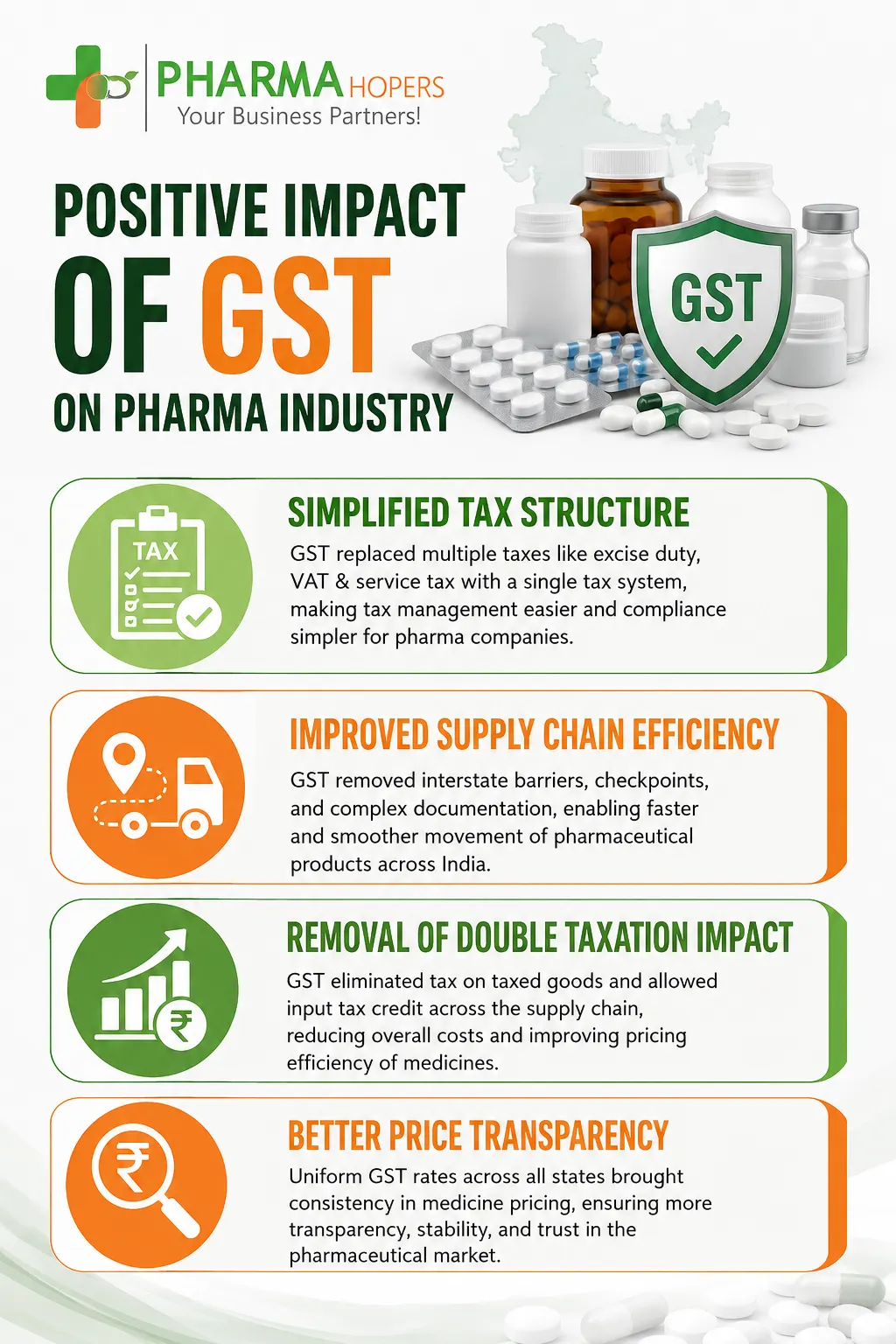
With the introduction of GST, the Pharma Industry experienced many positive changes. It helps improve efficiency, transparency and many more, let’s have a look:
- Simplified Tax Structure
When GST is not in effect, pharma companies need to deal with different taxes such as excise duty, VAT and service tax. They face many challenges, complexity and compliance procedures for managing taxes. After the introduction of GST, this tax management became much more simpler.
- Improved Supply Chain Efficiency
When the pharma industry moved medicines interstate, they had to face delays and slow-moving due to state-level taxes, broad checkpoints and even extensive documentation requirements. Once the GST was implemented, all these barriers were removed, and now pharmaceutical products move more freely across the country.
- Removal of Double Taxation Impact
Before GST, taxes were often levied on already taxed goods that directly impacts the overall cost of medicines and affects pricing efficiency. By the introduction of GST, these issues were eliminated and allowed input tax credit across the supply chain. With this, overall pharma medicine prices have reduced.
- Better Price Transparency
Before GST, the price of medicines was different from state to state due to local taxes and levies. This makes the whole business confusing and complicated. After the GST introduction, tax rates became uniform across India. With this, more stability and transparency come in medicine pricing.
What are the Negative Impact Of GST On Pharma Industry
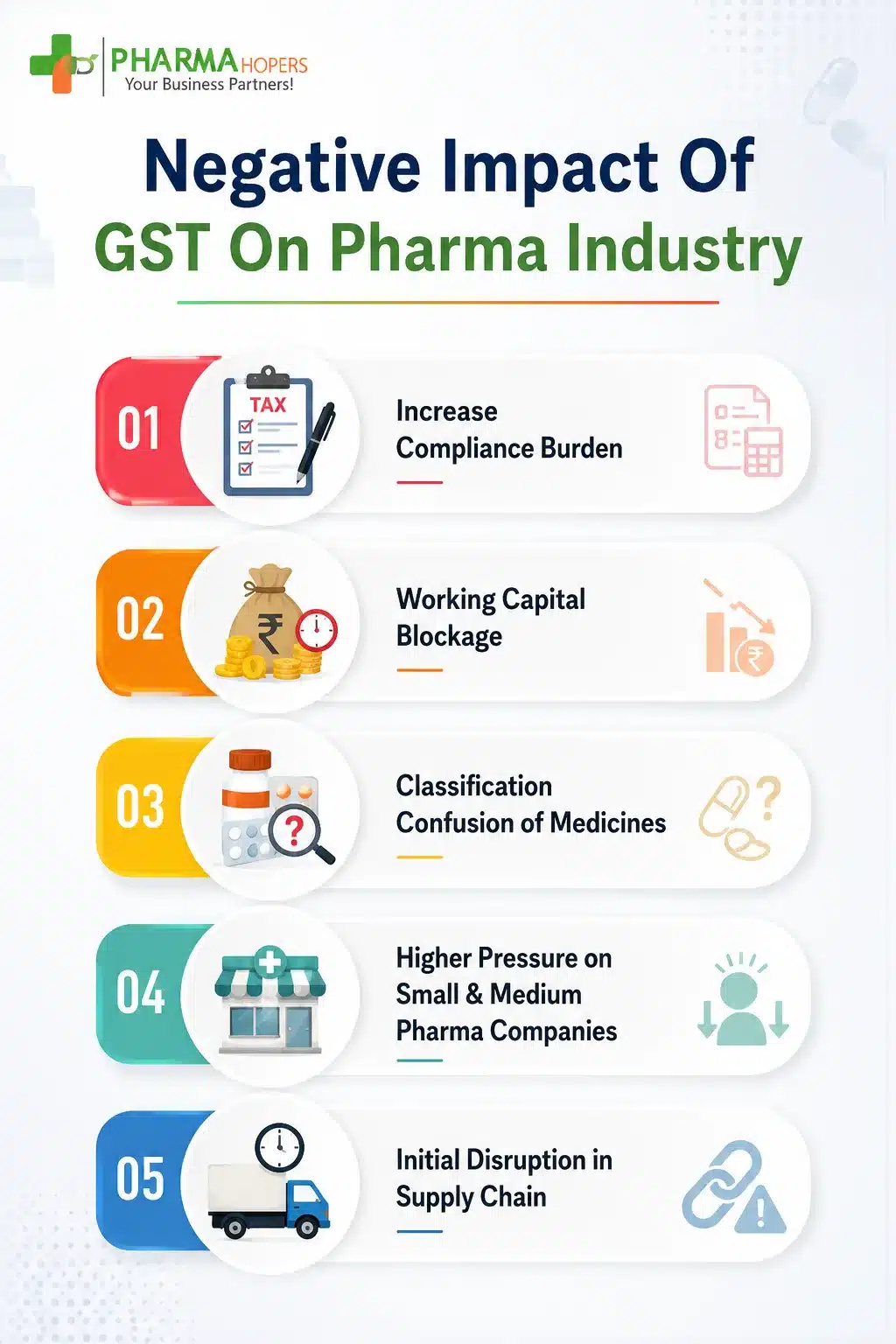
No doubt, GST improves efficiency, but it impacts negatively on many pharma companies. Let’s see:
- Increase Compliance Burden
Earlier, the tax structure was not digital, which is easy for pharma individuals. But with the GST evolution, it has become more digital and documentation-intensive. Pharma companies now file multiple returns and ensure accurate reporting at every stage, which directly increases the compliance workload.
- Working Capital Blockage
Under GST, Input Tax Credit refunds become slower and are delayed. Pharma manufacturers and exporters pay GST on raw material, packaging and logistics upfront,t but refunds are not always processed quickly. With this, working capital becomes blocked, and it affects day-to-day business operations.
- Classification Confusion of Medicines
Most pharmaceutical products fall under different GST slabs, like 0%, 5%. 12% and 18%, depending on their category. For pharma individuals, this creates confusion in product classification, especially in combination drugs, APIs and new formulations. Any minor classification error can result in penalties or legal disputes.
- Higher Pressure on Small and Medium Pharma Companies
Large pharma companies are equipped with better digital systems that make it easy to handle GST. But small and medium pharma companies face high pressure, including compliance costs, limited technical expertise and reduced financial flexibility. As a result, GST compliance has become more pressurized for small pharma businesses.
- Initial Disruption in Supply Chain
In the initial introduction of GST, the pharma supply chain was experiencing a temporary disruption, like adapting to the new taxation framework. During the transitioning phase, many pharma companies face short-term challenges such as delay in stock movement, inventory mismatches and operational adjustments.
Conclusion
Overall, the introduction of GST has brought major transformation in the pharmaceutical industry in India. The impact of this is mostly positive on pharma companies, like simplified tax structure, improving transparency and strengthening the supply, while the pharma industry needs to face some challenges due to GST. As this framework is continuously evolving, the pharma industry is expected to become more effective and streamlined while ensuring affordability with GST.
Frequently Asked Questions about the Impact Of GST On Pharma Industry
Question. What’s the final impact of GST on pharma industry?
Answer: Overall, GST has a positive and long term impact on the pharma industry, as it simplifies the tax structure, improves supply chain efficiency and reduces tax cascading.
Question. What challenges does the pharma industry have to face under GST?
Answer: Complex compliance requirements, frequent changes in tax rates, classification issues of medicines and working capital blockage due to delayed input tax credit refunds are the major challenges faced by the pharma industry with the introduction of GST.
Question. How can GST increase or decrease medicine prices?
Answer: GST can increase and decrease medicine prices, but it totally depends on the product category and the previous tax structure. For many essential medicines, GST has reduced prices, and some brand medicine significantly increased the prices.
Question. What is the impact of GST on generic medicines?
Answer: GST impacts positively on Generic medicines- taxed at lower rates or exempt in some cases. Not only this, but it supports wider public access.
Question. What about the future outlook of GST in the pharma industry?
Answer: The future of GST in the pharma industry looks more streamlined and technology-driven with expected improvements in rate rationalization, faster refunds and better compliance system.
Question. Is there any impact of GST on medical devices?
Answer: Yes, GST also affects medical devices as it is typically taxed between 12% to 18%, depending on the category.
Question. How does the GST impact hospitals?
Answer: Most major healthcare services provided by hospitals are exempt from GST that keeps patient treatment lower.
Question. How is GST impacting small pharma companies?
Answer: GST impacts small pharma companies both positively and negatively, as it makes interstate trade easier, but also has to face compliance costs and working capital constraints.